System Sensitivity
A key criteria when designing a seismic system is establishing the lowest magnitude that the system can reliably record (), referred to as the system sensitivity. The the system is designed for can vary in space and time as it will depend on the application of the system (Rock mass monitoring, Hazard assessment, Damage location).
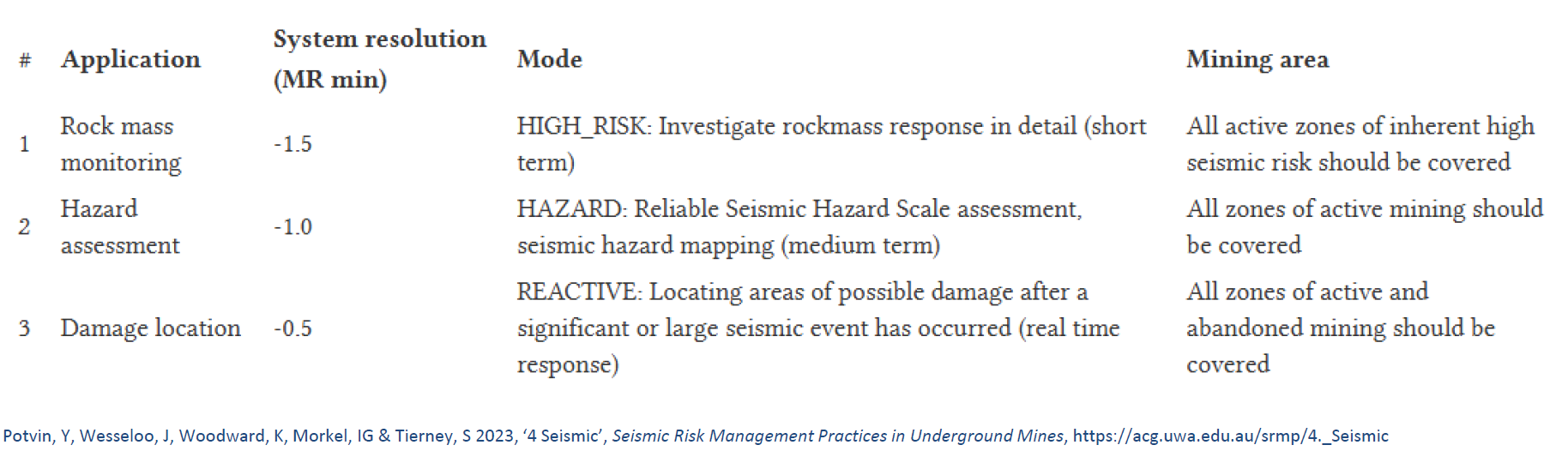
The system design app utilises your mine site seismic database (events and sensors) to calculate your system sensitivity across your mine through the use of grid and planes. Two approaches are used in the app. The first is to model the system sensitivity using your GMPE. Click this link here for GMPE theory. The second is using an empirical approach.
Assessing sensitivity using GMPE
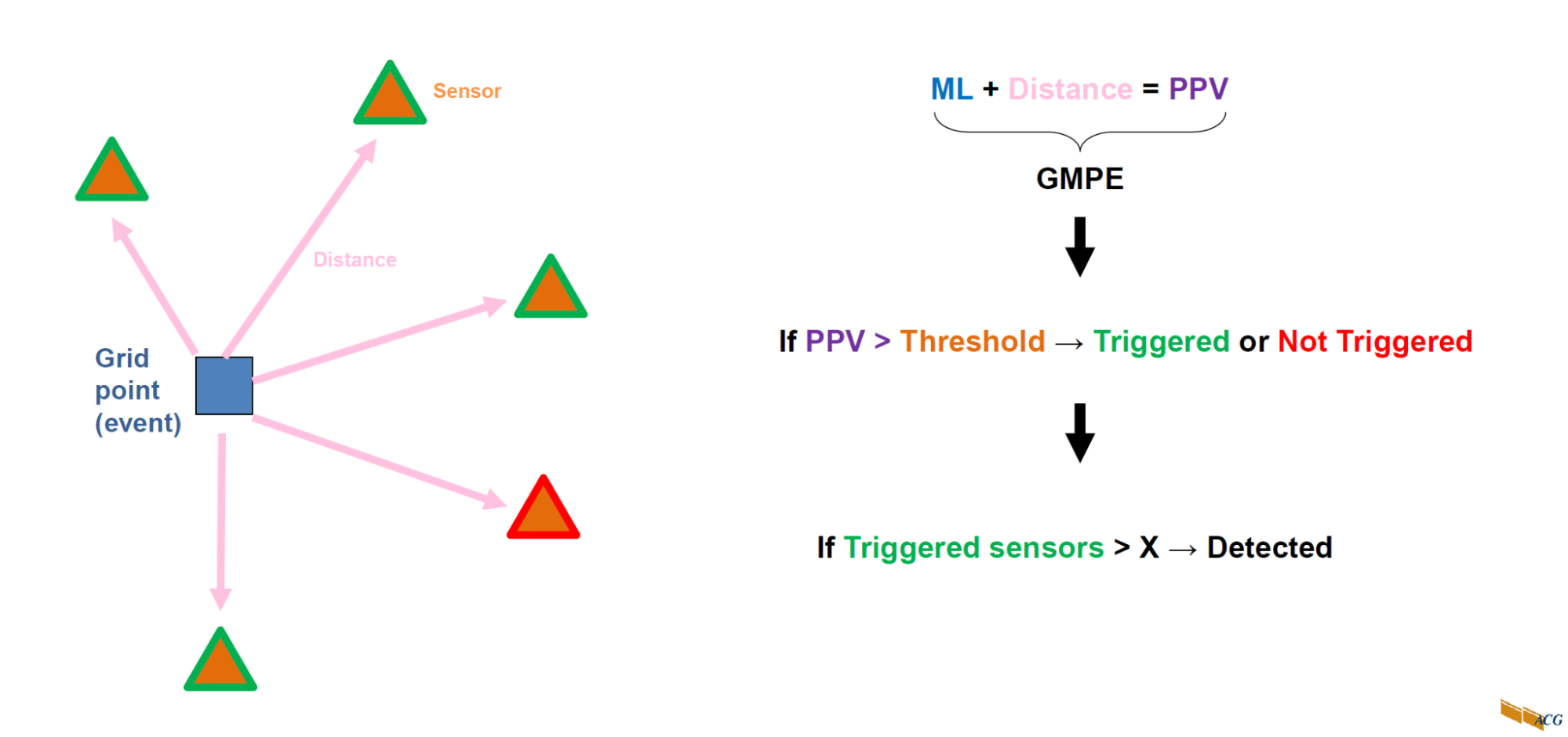
Your system sensitivity will be calculated on a grid or plane which represents the space where you wish to know the . Each grid point acts as an event location, and through an iterative process, the smallest magnitude that can be reliably detected at that location by your sensors is calculated. To do so, the minimum number of sensors triggered by an event needs to be determined as well as the trigger level of your sensors. The PPV (for geophones) or PPA (for accelerometers) at each sensor is calculated based on the distance to the grid point, the magnitude tested and the GMPE used (If you don’t know your GMPE, please contact mXrap support to enquire about getting your GMPE calibrated). If the PPV/PPA is greater than the trigger level, then the magnitude tested can be triggered by that sensor. If enough sensors are triggered, then the magnitude tested can be detected at that grid point.
GMPE based window configuration
Two kinds of analysis can be done in the GMPE based window: Historical and Forward analysis. Historical analysis windows allow assessment of the seismic system sensitivity at a point in time in the mine's life based on the sensors active that day. Forward analysis windows allows assessing the seismic system sensitivity when designing new systems or expansions to existing systems, along with the impact of losing sensors. Sensors can be added or excluded to assess the changes in the sensitivity.
Assessing sensitivity using empirical method
Another way of assessing your system sensitivity is through an empirical approach. The principles on which the System Sensitivity Assessment is based, is described in part in the following papers:
Wesseloo, J. (2011) Empirical methods for assessment of seismic system sensitivity.Mining Technology, 120(2). http://dx.doi.org/10.1179/037178411X12942393517534
This paper can be downloaded from https://www.researchgate.net/profile/Johan\_Wesseloo, or from https://uwa.academia.edu/JohanWesseloo
The preferred method of analysis of the mXrap team is using the GMPE based assessment, however the empirical method allows for independent verification and assessment for cases where a calibration has not yet been done for the mine.
Further development was done after the publication of the paper, however, the main principles remain the same. First, the number of sensors needed to process an event is set, then the distances between the events in the database and the furthest sensor needed to detect the event is calculated.These events are then placed into bins based on the distances and plotted in a frequency-magnitude chart, allowing to calculate the Mmin for each bin. A distance to Mmin relationship can then be calculated and plotted on a grid to show the sensitivity across the mine. The Empirical window will allow you to do just as such.